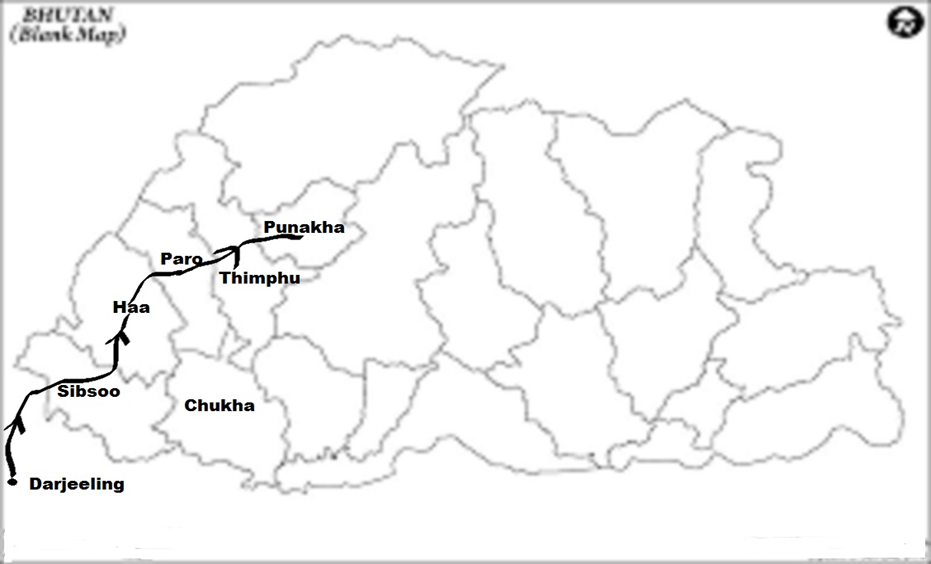
- The permanent occupation of the whole country of Bhutan.
- The temporary occupation of the country, to be followed by the withdrawal of the occupying force after destroying all the forts and letting the people see and feel our power to reach them at any future time.
- The permanent annexation of the that tract at the foot of the hills called the Duars and Jelpesh, which formerly and naturally belonged to Bengal, but which was partly wrested from the Mahomedan rulers of Bengal, and partly ceded by us at the end of last century.
- The lowest range of the Bhutan hills at elevations from 2000 to 3500 feet above the Duars would be necessary to take possession and occupy them; incorporate the hill territory with the Duars and make them frontier. He also strongly recommended the annexation of the tract of Bhutan between Darjeeling and Dalimkote.
The British Government in India
initially appears to take action leniently on Bhutanese and wanted to
permanently annex Ambaree Fallakota and withhold the annual compensation for
the Assam Duars. However, a demand was made to Bhutan Government that Bhutan
should surrender all British India, Sikkim and Cooch Behar subjects held in
captivity. British India would attack the Bengal Duars, if Bhutan failed to
surrender the above mentioned captives.
A sufficient time was given to
the Bhutanese Government to response and complies with the demand made by
British India. There was no response
from the Bhutanese Government. Therefore, preparations for the war were going
on. British India planned to attack Bhutanese frontiers on Dalingkha in the
west to Dewangiri in the East. The other
frontiers in the middle of the two extreme frontiers are Chamooche, Balla, Buxa
and Bishensigh.
On hearing the news that British
Indian Government was fully prepared for the war against Bhutan, then Bhutanese
Government sent a letter to Chebu Lama of Sikkim through the Dzongpon of Dalingkha. The following is the translation of the
contents of the letter:
“The
British say you were interpreter to the mission, we do not know what you said
and Eden did not know what we said, but you know whether the treaty was not
agreed to. We used no force, if we had, it should have been mentioned at the
time, and you should not have afterwards allowed Eden on his return to deceive
the Governor General and lead him to write to the Dharma Raja that we had used
violence. Our Bhutan custom is this, that an answer once given is given, and a
bargain made is made, so we did not tell the Desi of this. If the treaty made
last year is not allowed, if another right dealing person will come, or if a
representative is wanted from hence, write so, therefore, we have sent this
order to you, but if an attack made upon us is right or wrong, recollect that
you are responsible as the go-between. We cannot make restitution of anything
now. The low country is unhealthy also, and an envoy could not be sent; when
the sickness is less send for one. The case as regards robbery and theft is as
follows:
In
the Cooch Behar territory and ours, the faults are equal-besides the English
Government ha staken seven Talooks of the Dangsi Terai(the Assam duars), an
dthe rent of Ambaree Fallakata has been withheld for some years. These are
causes for our declaring war, instead of which the British Governmentare doing
it. Make them do right. If we can withstand them we will, if not we will remain
passive. Now you are the originator of confusion, you are a Sikkimese and we
shall have something to say to you; remember this and say it to the English
Authorities. Well, if there is no confusion between the British and the Dharma
Raja, there will be nothing to say between us. If you do make mischief it will
not harm us. Having considered all this, send your answer through the Dzongpon
of Dalingkha”.
The British Plan of attack Bhutanese
Frontiers[1]
The military authorities were informed by the British India Government that the forces were required to operate in Bhutan on 24th August 1864. Further the military authorities were directed to make plan of operations to attack Bhutan. The Bengal Government wanted to annex the duars from Daling to Dewangiri and not to invade the whole country. So, the Government believed that one regiment would be sufficient to seize and hold the all the eighteen duars.[2] But Sir Hugh Rose, the Commander-in-Chief, on 8th September 1864, stated that a larger detached column is required as the Bhutan is a mountainous country drained by large rivers and swamps. The Commander-in-Chief anticipated that the chief dangers to be guarded against were that the Bhutanese might induce the Tibetans and other tribes to join them. Therefore, he recommended that four columns should be formed to attack on Dewangiri, Sidli, Buxa, and Dalingkha.[3]
As a result, the military was
divided into four columns. The soldiers of the right column would attack
Dewangiri from Gauhati. British’s aim was to distract attention of Bhutanese
and make Bhutanese to divide the forces and the other aim was to protect their
right flank from any attack from the Abors and Mechs. This shows that British
did not expect such strong reaction from Bhutanese. The soldiers of the right
centre column would march towards Bishensigh from Goapara. Here also British
did not expect any opposition from Bhutanese. While the soldiers of the left column would
attack Dalingkha and Chamuchi from Jaipalguri, this column should protect any
attack from Sikkim and Tibet. The soldiers of the left centre would attack Balla
and Buxa from Cooch Behar. British considered the column is the strongest among
all the four columns and expected strong fight from Bhutanese forces.
On 4th September 1864, the
Government of India approved the above measures. The inhabitants of the duars
were asked to remain quite and provide helps to British. In return, British
promised that they would protect the life and properties of people.
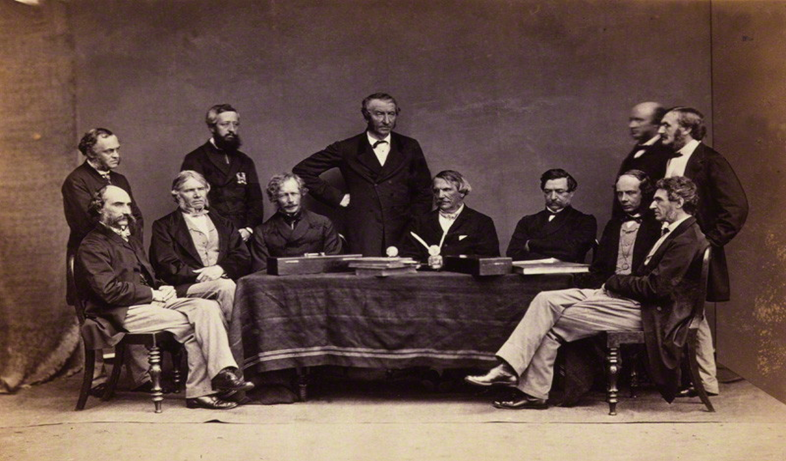
Instructions were also issued that no overtures from the Bhutan Government were to be taken into considerations except upon the following basis:[4]
- That the Bhutan Government surrender all the Bengal Duars and the hill territory on the left bank of the Tista river;
- That
the Bhutan Government give up the two documents extorted from from Mr. Eden and
send a chief of rank to apologise for the misconduct towards the envoy;
- The surrender of all captives still detained in Bhutan against their will;
- That the Bhutan Government enters into a treaty of friendship and fair dealing for the future.
British India Government had the following field
forces during the Bhutan Duar war in 1864-65:
Right Column (Dewangiri)
Three Mountain Guns
of Eurasian Artillery Company
One Squadron 5th
Bengal Cavalry
3rd Assam Light Infantry
One Coy Sibundy
Sappers
One Coy Bengal
Sappers
In support at Gauhati
Three Coys 12th
Native Infantry
Assam Local Artillery
Right Centre Column
(Bishensigh)
Three Mountain Guns
of Eurasian Artillery Company
One Squadron 5th
Bengal Cavalry
Two Squadrons 14th
Bengal Cavalry
One Coy Sibundy
Sappers
Half Coy Bengal
Sappers and Miners
One wing 44th
Assam Light Infantry
In support at
Goalpara
Two Coys 12th
Native Infantry
Left Centre Column (Buxa)
Half Armstrong
Mountain Train Battery
Two 8-inch Mortars
2nd Gurkhas
11th Native Infantry
One Squadron 14th
Bengal Cavalry
Left Column (Daling)
Two Armstrong
Mountain Guns
Two 8-inch Mortars
One Coy Sibundy
Sappers
One Wing 11th
Native Infantry
Two Squadrons 5th
Bengal Cavalry
In support at
Jalpaiguri
Seven Coys HM
80th Foot
Source:
(https://wiki.fibis.org/w/Duar_War)
Brigadier General Mulcaster was
appointed to command the Duar Field force and Brigadier General Dunsford to
command the two left columns under the Brigadier General Mulcaster’s direction.
The Commander-in-Chief also recommended that two civil officers should
accompany the columns in order to gain a thorough acquaintance with the
country. Accordingly, Lieutenant- Colonel Haughton was appointed Chief Civil
and Political Officer, Captain Lance and Mr. Donoghue were posted to the left
columns, and Mr. Metcalf and Mr. Dribeng to the right.
The military preparations were
completed by the end of November 18964 and force was ready to take the field.
The plan was to attack all the four Bhutanese frontiers at the same time but
did not. The right column could start only after some days while right centre
column some weeks due some transportation problems.
In early November 1864, the military preparations for the annexation of the Bengal Duars and the capture of the Forts in the lower range of hill were completed. The following proclamation was issued by the Governor General to the Bhutan Government.
Proclamation of War 1864
For
many years past outrages have been committed by subjects of the Bhutan
Government within British territory, and in the territories of the Rajahs of Sikkim and Cooch Behar. In these outrages property has
been plundered and destroyed, lives have been taken, and many
innocent persons have been carried into and are still held in captivity.
The
British Government, ever sincerely desirous of maintaining friendly relations
with neighboring States, and specially mindful of the obligations imposed on
it
by the
treaty of 1774, has endeavored from time to time by conciliatory remonstrance to induce the Government of Bhutan to punish the perpetrators
of these crimes, to restore the
plundered property, and to liberate the captives.
But
such remonstrances have never been successful, and, even when followed by
serious warning, have
failed to produce any satisfactory result. The British Government has been frequently deceived by vague
assurances and promises
for the future, but no property
has ever been restored, no captive liberated, no
offender
punished, and the outrages have continued.
In 1863 the Government of India, being averse to the
adoption of extreme measures for the protection of its subjects and dependent
allies, dispatched a special mission to the Bhutan Court, charged with
proposals of a conciliatory character, but instructed to demand
the surrender of all captives,
the restoration of plundered property, and security or the future peace of the
frontier. This pacific overture was insolently rejected by
the Government of Bhutan- Not only were
restitution for the past and security for the future refused, But the British
Envoy was insulted in open Darbar and compelled, as the only means of ensuring
the safe return of the mission, to sign a document which the Government of India could only
instantly repudiate.
For
this insult, the Governor Genera1 in Council determined to withhold forever the
annual payments previously made to the Bhutan Government on account of the
revenues of the Assam Dooars and Ambaree Fallacottah, which had long been in
the occupation of the British Government, and annexed those districts
permanently to British territory. At the same time, still anxious to avoid an
open rupture, the Governor-General in Council addressed a letter to the
Deb and Dhurma Rajah, formerly demanding that all captives detained in Bhutan
against their mill should be released and that all property carried off during
the last five years should be restored.
To
this demand the Government of Bhootan has returned an evasive reply, from which
can be gathered no hope that the just requisitions of the Governmentt of India
will ever be complied with, or that the security of the frontier can be
provided for otherwise than by depriving the Government of Bhootan and its
subjects of the means and opportunity of future aggression.
The
Governor-General in Council as therefore reluctantly resolved to occupy
permanentlv and annex to British territory the Bengal Dooars of Bhootan, and so
much of the Hill territory, including the Forts of Dalimkote Punakha and Dewangiri, as may be necessary to
command the passes, and to prevent hostile or predator incursions of Bhootanese
into the Darjeeling districts or into the plains below. A Military Force amply sufficient to occupy this tract
and to overcome all resistance has been assembled on the frontier, and will now
proceed to carry out this resolve.
All
Chiefs, Zamindars, Munduls, Ryots, and other inhabitants of the tract in
question are hereby required to submit to the authority of the British
Government, to remain quietly in their homes, and to render assistance to the
British troops and to the Commissioner who is charged with the administration
of the tract. Protection of life and property and a guarantee of all private
rights is offered to those who do not resist, and strict justice will be done
to all. The lands will be moderately assessed, and all oppression and extortion
will be absolutely
prohibited.
The future boundary between the territories of the Queen of England and those
of Bhootan will be surveyed and marked off, and the authority of the
Government of Bhootan within this boundary will cease forever.
By order of the Governor-General in Council
Fort William, H. M. Durand, Colonel,
The 12th November
1864. Secy. to the Government of India
Operations of the two Left Columns:
On 28th November 1864, an advanced party of the Daling Column, under Major Gough, V.C. and Major Pughe marched from Jalpaiguri to Bakali where a small outpost of Bhutanese called Gopalgan was taken without any resistance. On 29th November 1864, they marched to Maynaguri where the Bhutanese stockade was found empty. On 30th November, Major Gough’s team went to Domohani and found that a small stockade was deserted by Bhutanese soldiers.
On 1st December, Brigadier
General Dunsford’s column came to Domohani and halted a day there. On 3rd
December the column proceeded to Kyranti and on 4th, the column reached near the
pass leading to Dalingkha. On 5th December the column marched towards Ambiokh,
the village below the Daling Dzong. On the 6th morning, British Indian forces
moved and attacked the Daling Dzong by guns and mortars from Ambiokh. They were
climbing up the steep slope towards the Dzong of Daling where they received
stones and arrows and two men were killed including the officers. At last they
could capture the Dzong of Daling but the victory did not come ease. On 10th
December, the Dhamsang Dzong was also captured without resistance from
Bhutanese.
Brigadier General Dunsford kept a
garrison at Dalingkha and moved down to the plains to march towards Chamurchi next.
On 29th December, an advance team was sent to examine the position of the
Chamurchi and to occupy it if it was undefended. Here, they were attacked by
the Bhutanese and twelve men were wounded. On 31st December, Brigadier General
Dunsford came with the main column and took the position and on the 1st January
1865 British forces attacked the Dzong by shelling. The Bhutanese soldiers
immediately evacuated the Dzong. In the ensuing battle thirteen Bhutanese
soldiers were killed and while two of British Indian men killed and three
wounded.
After keeping 100 men at
Chamurchi, Brigadier General Dunsford proceeded to Balla and Buxa to inspect
the posts there with fifty men on 2nd January 1865. The British forces at Balla
and Buxa column were commanded by Colonel Watson. From Cooch Behar, Colonel
Watson marched on 28th November to Chicha kota. On reaching Chicha kota, they
found the place was abandoned by Bhutanese.
The main column moved further and on 7th December, took possession of
Buxa without resistance. From Buxa, the column returned to the plains and then
marched westward and had occupied the Balla pass.
The Operations of the two Right Columns:
On 2nd December 1864, the
soldiers of the right column moved from Goahati under the command of Colonel
Campbell who was accompanied by Brigadier General Mulcaster and on 3rd the
column reached at Kumrikatta where a standing camp was established. On 7th
December, an advance party of fifty Bengal Police was sent to Dewangiri under
Captain Macdonald. On 9th they marched to Darranga pass. On the morning of the
10th, when they were about to enter the hills of Dewangiri, they were attacked
by a Bhutanese man from a stockade and one British soldier wounded. It was
found that there were fifty Bhutanese men behind the Stockade. After halting
the previous night at plain, on the morning of the 11th December, the British
soldiers advanced to Dewangiri but found that the Stockade was deserted by
Bhutanese soldiers.
Captain
Macdonald and his men managed to reach at Dewangiri. He stopped near the
temple. He anticipated that the place would give up without resistance. He
moved further and came across a stone house. In a moment, he received a volley
of arrows and stones. One of his men wounded from a single jingal shot. Captain
Macdonald took up a position and then he saw a Bhutanese man rushing towards
him with spear. The Bhutanese man was shot dead by the policeman. On storming
the house by the Captain Macdonald and his men, Bhutanese retired (Rennie).
When Brigadier General Mulcaster
was on the process of marching towards Dewangiri, a message was received from
Captain Macdonald that he had captured the Dewangiri on the previous night.
Therefore, Brigadier General Mulcaster pushed towards Dewangiri with three
companies. On his arrival at the Dewangiri, he found that the Dzongpon of Dewangiri
and his men left the Dewangiri to Shalikhar Dzong. The rest of the column came
to Dewangiri on 12th December 1864.
On 17th December, the column was
divided. They kept six companies of the 43rd, and half No. 9 Company of
Bengal Sappers and Miners, with two mountain howitzers and fifty 6-pounder rockets
as a garrison. The rest of the column returned to Kumrikatta. On 26th December,
Brigadier General Mulcaster left Dewangiri to join the Colonel Richardson who
was commanding the right left centre from Goalpara to Bishensigh. On 29th
December, Brigadier General Mulcaster arrived at Sidlee. Then the column
marched towards Bishensingh which was forty-two miles distant. On 5th January
1865, the column approached towards the Bishensingh and on 8th January, the
column finally reached at Bishensingh.
Brigadier General Mulcaster went
on ahead with three hundred men of the 12th and 44th regiments of Native
Infantry to storm on the Fort of Bishensigh. But on his arrival at the fort, he
found the only single stone house which was occupied by an old lama. The fort
at Bishensigh seemed to use by the Wangdi Dzongpon as a temporary residence
when he came down for short winter.
The storming was over. Like in
Dewangiri, the force was breaking up. The three companies of the 44th Native
Infantry and fifty of the Bengal Police were kept as garrison here at
Bishensigh. The two squadrons of the 5th Bengal Cavalry sent to Jalpaiguri and
the rest returned to Sidlee. Then Brigadier General Mulcaster left to Guahati.
The Bhutanese Preparations for War
The British thought that war was
over then and they were on the process of breaking up the force, the Bhutanese
were preparing for the war. Bhutanese determined to attack all British
frontiers right from the Dewangiri in the east to Chamurchi in the west. Enough
warnings were given by the Bhutanese to British but British did not pay
attention and took lightly.
Meanwhile, Bhutanese Government
sent Kalyon to Buxa region and Paro Penlop, and Zhung Dronyer to Tazagong
(Balla). But MacGregor wrote that Thimphu Dzongpon, Daga Penlop, and Zhung
Dronyer were also sent to Buxa Duar. The strength of the force was estimated at
round 1200 men. MacGregor further wrote that Paro Penlop, Punakha Dzongpon, Deb
Zimpon and Lamai zimpon were sent to Tazagong (Balla). The strength of the
force was estimated at round 2050 men.
On 30th January 1865 morning at
five o’clock, Bhutanese soldiers crept into the camp at Dewangiri, and cut the tent ropes.
Then the attack became general after sometimes. But the British troops defended
their camp and able to keep away the Bhutanese force till the dawn. The
Bhutanese force was led by the Trongsa Penlop Jigme Namgyal himself in person.
The British casualties included the dead of Lieutenant Urquhart and four men,
and Lieutenant Storey,
43rd Native Infantry and thirty-one
men wounded. But Bhutanese loss was
estimated about sixty men. The dead of the Jakar Penlop was one of the sixty
men.
Over the next three days, British
force was continually attacked by the Bhutanese day and night, although they
were driven away from the camp. Bhutanese also cut off the water supply to the
British camp. On the 3rd February Bhutanese threw up a stockade near the camp
and during the night took the possession of the Darranga pass, thereby blocking
communications with the plains.
British troops were then getting
short of water. They felt that the available force at the camp was not able to
dislodge the enemy. Therefore, they asked for the reinforcement on 30th
January. But Brigadier General Mulcaster from Gauhati denied saying that the
force at Dewangiri is enough for its defense. However, a
supply
of 25,000 rounds of ammunition was sent but it could not reach to Dewangiri as
the communication with the plain was blocked by Bhutanese force.
On February 4th, as the water was
running short, Colonel Campbell made up his mind to evacuate the place that
night, and retreat to the plain by another pass.
To retreat, the following
arrangements were made that two hundred and fifty men were told off - to carry and
escort the sick and wounded, 50 to carry the two twelve pounder
howitzers, and 200 men to form the advance and rear-guards. On 5th February
morning at one o’clock Dewangiri was evacuated quietly. Unfortunately, the
troops of the main column lost the way and became panic which caused further
disorder in their marching. Troops had to leave some wounded behind them and
the guns abandoned. They threw the guns in the deep ravine so that Bhutanese do
not notice them. However, Bhutanese saw the abandoned guns and fell in the
hands of the Trongsa Penlop. Trongsa Penlop Jigme Namgyal took the guns to his
seat at Trongsa, which affects the prestige of the British power in India. MacGregor
estimated the strength of the Bhutanese force at Dewangiri was about 2500 men.
This episode at Dewangiri
wondered the British military officers by the behavior of the Trongsa Penlop
Jigme Namgyal. Earlier Eden reported that Jigme Namgyal was arrogant, hard
hearted and rude person. But here at Dewangiri, Jigme Namgyal was found to be
otherwise. Jigme Namgyal after the evacuation of the war sent a letter to the
military camp of British India at Koomrekatta inquiring about the health of the
Bhutanese soldiers who had been captured by Britisth and informed the British
military officers that British soldiers captured by Bhutanese are in good
health. Jigme Namgyal even sent some money to be used for expenses incur while
sending him a reply. Jigme Namgyal was a man of tolerable and found to treat
the prisoners well. He was kind to the British messengers who had been sent up
to him. He fed them well and gave some presents.[6]
Jigme Namgyal had shown such a kind action, when he was helping the Punakha Dzongpon against the Wangdue Phodrang Dzongpon. In the battle, Jigme Namgyal killed Shar Drungpa of the Wangdue Phodrang Dzongpon. But the Thimphu Dzongpon Karma Druggye and Wangdue Dzongpon Sigyal appeared before Jigme Namgyal and requested to pardon them. Jigme Namgyal readily accepted their request and saved their lives.
At Buxa also, Bhutanese force
offered tea and drink. Bhutanese force treated kindly a British soldier and
allowed to go his own ways.[7]
Bhutanese
counter attack at Bishensingh
While Trongsa Penlop Jigme Namgyal and troops
attacked British force at Dewangiri, Bhutanese also made an attack on British
in the right centre frontier and left and left centre frontiers also. On 25th
January, Bishensingh was attacked by many Bhutanese troops, although the
Bhutanese were beaten off. The responsibility to counter attack the British at
Bishensingh was given to Wangdi Dzongpon by the Bhutanese Government. But he did
not command the Bhutanese troops in person. The British casualty was only two
men wounded by Bhutanese arrows. The strength of the Bhutanese force was
estimated at 400 men only.
Bhutanese counter attack at Buxa
To
counter attack the British force at Buxa, Bhutanese Government sent Kalyon.[8]
But MacGregor wrote that the Bhutanses force at Buxa was commanded by Thimphu
Dzongpon, Daga Penlop, and Zhung Dronyer.
On 3rd
February, the officer in command at Buxa Duar captured a Bhutanese spy who
informed that large Bhutanese forces would be reaching at Buxa to counter
attack the British on the following day. British troops also saw some Bhutanese
but they disappeared on firing at them. On the 6th Lieutenant Gregory with 150 Gurkhas proceeded to
attack a stockade which the Bhutanese force had built
during the previous night. But the troops not able to storm the stockade had to
return with the dead of two officers and thirteen men wounded by the bullets
from the matchlock guns of the Bhutanese.
However, the Bhutanese were driven away a few distances from their post
on 9th. By 11th January, the Buxa Duar became a safer place for the British
troops.
Bhutanese Counter attack at Balla (Tazigang)
British had garrisoned about
fifty
men
of the 11th Native Infantry at Balla (Tazigang) earlier. On 27th morning,
Bhutanese forces attacked them. Bhutanese fought with determination and
attempted to force their way into the British Stockade. However, they were
repulsed by the British troops. During this battle, British lost one man killed
with six men wounded. Bhutanese casualty was not known.
On 4th February, Colonel Watson
came with reinforcements. The reinforcements included two Armstrong guns and a mortar. British troops
attempted to capture the stockade but could not. Then they retired with the
dead of two officers and many men wounded.
The Bhutanese forces were commanded
by Paro Penlop, Punakha Dzongpon, Deb Zimpon and Lamai Zimpon. But Bhutanese
source does not mention Lamai Zimpon. Instead, Lamai Zimpon was sent to
Dewangiri with Trongsa Penlop Jigme Namgyal. Zhabdrung Jigme Norbu was born to
former Trongsa Penlop Chogyal Tenzin who was brother of Sonam Dendup. Sonam
Dendup served as the Zimpon for Zhabdrung Jigme Norbu. Since then people
addressed Sonam Dendup as Lamai Zimpon. During this Duar war time, he was
retired lamai Zimpon. The strength of the Bhutanese force was estimated at 2050
men.
Bhutanese
Counter attack at Chamurchi
Simultaneously,
Bhutanese forces also made a counter attack at Chamurchi frontier. Earlier,
British kept s a detachment of 150 of the Bengal Police. Bhutanese forces took
up strong position behind the stone wall. Major Pughe who commanded the Bengal
Police force found that he could not dislodge the Bhutanese forces. Then he
asked reinforcements from Brigadier General Dunsford. He received about 150 of
the 30th Punjabees and two mortars commanded by captain Huxham. They attacked
Bhutanese and had driven away to the Plain. Once again, Bengal Police took hold
of their earlier position whereas the Bhutanese confined themselves to their
own entrenchment.
The Bhutanese force at Chamurchi
was commanded by Sombekha Dzongpon. The strength of the Bhutanese force was
estimated at about 150 men.[9]
British changed the Commanders of the Duar Field Force
When
the news of defeat of British forces at Dewangiri and Balla reached Calcutta,
immediate preparations were made to regain their prestige and also to
strengthen the remaining posts which were their control.
The
following reinforcement were made and dispatched to the north east frontiers:
- Two batteries Artillery.
- H. M.'s 55th Regiment.
- Hd. -Qrs. H. M.’s 80th Regiment.
- 19th Punjab Infantry.
- 29th Punjab Infantry
- 31st Punjab Infantry
The total strength of the British
force in the north east would be 1,300 British Infantry, 2,000 Native Infantry, and 100 artillerymen,
in addition to the already large force in the Duars.
Meanwhile,
the previous Commanders Brigadier
General Mulcaster and Brigadier General Dunsford
were replaced by Brigadier
General Frazer Tytler, C. B., and Brigadier General Tombs C.B., V.C. Brigadier
General Tombs C.B., V.C. was appointed to replace the Brigadier General
Mulcaster of the Right column and Brigadier General Frazer Tytler, C. B. was
appointed in place of Brigadier General
Dunsford of the Left column.
The new reinforcements were allocated as follows:
|
Left Column (Jalpaiguri to Dalingkha
and Chamurchi) |
Left Centre Column (Cooch Behar to
Buxa and Balla) |
Right Centre Column (Goalpara to
Bishensigh) |
Right Column (Guahati to Dewangiri) |
|
One battery,
the left wing, 55th Regiment, the headquarters, 80th Regiment, No. 2 Company,
Bengal Sappers and Miners, and the 31st Punjab Infantry |
the 19th
Punjab Infantry |
|
One battery,
the Head-Quarter, 55th Regiment, and the 29th Punjab .Infantry |
|
the
5th Bengal Cavalry |
|
|
the
14th Bengal Cavalry |
|
Two 6 pounder guns and two 24-pounder howitzers
with 300 rounds |
|
|
|
|
Brigadier General Frazer Tytler, C. B. |
Brigadier General Tombs C.B., V.C |
||
Unlike in the past, the whole force was divided into two independent commands. The right brigade was under the Brigadier General Tombs C.B., V.C. and the left brigade under the Brigadier General Frazer Tytler, C. B.
On
7th March, General Tombs arrived at Guahati. From Guahati, he went on to
Kurnrikatta camp to make the preparations to attack Dewangiri. On 10th March,
the British force at Bishensigh was ordered to return to Guahati carefully.
General Tombs reported to Quartermaster-General that Bhutanese should be
blockaded at their hills. To do this, a force of 400 infantry and 50 mounted
police should be set up to carry out patrolling along the Bhutanese foot hills.
On 29th March, the following troops were collected at Kurnrikatta camp:
- No. 3 Battery, 26th Brigade, Royal Artillery.
- Eurasian Battery of Miery.
- Head-quarters and right wing 66th Foot.
- No. 7 Company, Bengal Sappers and Miners.
- 12th Regiment, Native Infantry.
- 29th Regiment,
Native Infantry
- 43rd Regiment, Native Infantry
- Head-quarters and 5 companies, 44th Native Infantry.
- 100 Duar Police.
Vigorous preparations were
carried out for the recapture of Dewangiri. In order to deceive the Bhutanese
forces, General Tombs built a small post at the Shobangkatta pass and kept a
garrison consisting of one company of Sappers and Miners, a detachment of the
12th Native Infantry, three companies of the 29th Native Infantry, two
companies of the 43rd Native Infantry, and a troop of the 14th Bengal Cavalry,
under the command of Major Langmore. Major Langmore had to patrol the pass
daily. The Bhutanese forces were
deceived well. Growing alarmed, Bhutanese forces came in large numbers in the
pass. They built numerous stockades there. While they concentrated in this part
of the pass, they left the other passes unguarded.
On 31st March, Major Langmore was
recalled but the tents were kept as usual under the charge of two companies of
the 43rd Native Infantry. This was done to deceive the Bhutanese forces.
Dewangiri recaptured by the British
Different opinions were expressed
by different British officials with regard to the recapture of the Dewangiri.
The agent of the Governor General in North East Frontier, Mr. H. Hopkinson
suggested to postpone the recapture of Dewangiri in the coming winter season,
while Lieutenant Governor of Bengal favored the immediate recapture of the Dewangiri.
The Governor General, Sir John Lawrence also expressed his concern that if they
go head with their idea of immediate recapture of Dewangiri, it may affect the
troops’ health and troops may not able to accomplish the tasks but the members
of Council wanted to go for immediate recapture of the Dewangiri. Then Governor
General left the task to Brigadier General Tombs.[10]
Therefore, on 1st April, the
British troops advanced towards Dewangiri commanded by Colonel Richardson,
whereas General Tombs would join them in the following day. Colonel Richardson’s
forces included the following:
- Eurasian Battery.
- 1 Company, Bengal Sappers.
- 1 Company, 56th Foot.
- 3 Companies, 12th Native Infantry.
- 3 Companies,
29th Native Infantry
- 1 company, 43rd Native Infantry
- 4 Companies, 44th Native Infantry
On the morning of 2nd April, on
the arrival of General Tombs, Colonel Hume with the main column reported
General Tombs that the rear guards were also well up the pass of the Dewangiri.
On April 3rd General Tombs
determined to attack. At 10-30 A.M. the troops were
formed up for the attack, and fire was opened from two mortars and two
howitzers. The advanced party charged and stormed the position. Some of the
Bhutanese troops fled, but about 150 of them barricaded themselves in the large
wooden blockhouse determined to fight to the last.
Captain Trevor, Lieutenant
Dundas. R.E.
and
Major Sankey gallantly fought through this small opening. The Bhutanese
casualties were about 100 dead and about 40 were found breathing for the last.
British made another attack on the house of the Dzongpon of Dewangiri and also
on the Shombhangkatta pass. But the Bhutanese troops fled. However, there were
some casualties inflicted on the Bhutanese troops. Jakar Ponlop Tsondroe
Gyaltshen was killed in the battle.
General Tombs said that the Bhutanese
fighting men were about 3000 at Dewangiri. Including all arms, British had 1800
men. During this battle, British lost four officers and about 30 men wounded.
Dewangiri
was being completely taken over the British troops, decided to evacuate the
place. After destroying all the forts at Dewangiri, they returned to
Kumrikatta. The last detachment arrived at Kumrikatta on 6th April. Orders were
issued to break the Brigade, after keeping the garrison on important posts. On
April 23rd, General Tombs handed over the command of the Right Brigade of the
Duar field force to Colonel Richardson.
The Left Brigade
Now
let us switch on to the left brigade of the Duar Filed force. General Frazer
Tytler took over the command of the left Brigade on 15th February 1865.
Immediatley he began to make through inspections all the posts under his
command that included Darjeeling, Dhamsang, Dalingkha, Chumarchi, Balla and
Buxa. General Tytler next made a plan to attack Balla where Bhutanese troops
were holding the force.
The
British troops to attack Balla pass were as follows:
- A wing of the
18th Regiment of Native Infantry
- The 19th
Punajabees
- The 30th
Punajbees
- The Armstrong
guns and mortars
On the night of March 13th,
Captains Perkins and deBourbell, R.E, and Lieutenant Cameron, R.A., were sent
to inspect the ways that leads to the Fort. They had marched two and a half
miles up the spur and returned without having been discovered.
On 14th March, they gathered on
the right bank of the river Torsa hidden themselves from the Bhutanese. The
other troops under the command of the Colonel Watson would attack the front of
the Bhutanese position. There was no sign of the presence of the Bhutanese
force. It seemed that the place was evacuated. Just to make sure if Bhutanese
had evacuated or not, Brigade Major MacGregor with a few troops proceeded
forward. In a moment, he received a bullet from a fire and his four men
injured.
British attacked on Balla Stockade
The stockade at Balla (Tazigang)
was stormed by the British troops and burnt down the stockade. The sepoys of
the 18th and 19th were also fought gallantly and drove the Bhutanese out.
During this battle, the Bhutanese lost was 46, while three men killed and
British lost one officer killed and wounded 19 men.
British attacked
Buxa
After
the completion of the storming of Balla stockade, the British troops turned to
Buxa then. British troops took the possession of the Buxa without opposition
from the Bhutanese. This was because the Dzongpon of Buxa who was commanding expressed
his willingness to give up the arms. To prove his sincerity, he immediately
evacuated the place and burnt the stockades. Thus, Buxa fell in the hands of
British with ease.
British attacked Chamarchi
On the 24th of March, General
Tytler marched for Chumarchi. To attack the Chamarchi Fort, British had the
following strength of the Forces:
- two guns
- one
8-inch and two 64-inch mortars
- 160
police
- 420 infantries.

The battle fields of Duar war
Note: The routes are not to the
scale
Upon reaching at Chamarchi
frontier, they shot a few rounds of guns. Then Bhutanese evacuated the stockade
at Chamarchi. The Chamarchi also fell into the hands of British without even a
slightest opposition.
With the end of the Duar War,
General Frazer Tytler took over the Commandership of the Duar field force as
the General Tombs returned to Gwalior. Guahati was made the Headquarters of the
Duar Field Force.
British India and Bhutan signed Treaty in 1865
Bhutanese did not show the
willingness to sign the treaty British proposed. However, there were frequent
correspondences being carried out to negotiate the peace between the two
countries. In May 1865, Bhutanese sent Envoys to British India for asking the
restoration of the Bhutanese territories annexed by the British India which
British Government in India declined.[11]
Then, in the month of June 1865, British India decided to send military expedition to Punakha and Trongsa. They planned to invade Punakha by the British troops of Buxa and the troops of the Dewangiri to attack Trongsa. On June 5, Governor General sent a letter to the Desi of Bhutan informing him that the offer of peace is still open. On 13th July, two Bhutanese retainers of the Desi came to India and presented the letter to Colonel Bruce, which stated that Desi was in favor of signing the peace treaty.[12] However, British could not trust Bhutanese. British had to go ahead with their plan to invade Bhutan. Therefore, Brigadier General Frazer Tytler was promoted to Major General and appointed the supreme commander of the force and Brigadier General W.W. Turner, C. B. was nominated as second command.
Colonel Bruce succeeded Colonel
Haughton on 1st November 1865.[13]
Colonel Bruce was told to continue the negotiation with the Bhutanese counter
part. He was empowered to increase the amount of subsidy from Rs. 25000 to
50000.[14] He
was also further instructed to insist the restoration of the two guns and to
ensure that the British boundary with Bhutan should be from the Bhutanese hills
above the plains.[15]
British resorted to negotiate the
peace with Bhutan diplomatically because the preparations of the military were
not ready and moreover the supreme Government at England did not approve the
invasions of Punakha and Trongsa.[16]
On 6 November, 1865, British
received Bhutanese envoy who informed the British India their acceptance
of the terms of peace laid down by
British but expressed the their inability to surrender the two guns as the guns
were with Trongsa Ponlop Jigme Namgyal.[17]
On 8 November 1865, Bhutanese
Desi sent his representative to deliver the copy of the treaty which Eden had
signed it at Punakha under the force of the Bhutanese authorities.[18]
When Eden came to Punakha with
draft treaty to be signed by Bhutan, Bhutanese authorities objected articles
eight and nine. At Sinchula also, Bhutanese representatives objected articles
two and nine. But British pressed on Bhutan through persuasion and
intimidation. Therefore, Bhutan had no alternatives/options than to agree upon
to the British desires. Finally, on 11 November 1865, the treaty was signed at
Sinchula.
The Prevention of Duar War 1865
Was there any possibility of the
prevention of the war between British India and Bhutan then? I would say, yes. There
were definitely certain ways and means to avert the war. British Indian
Government could send the mission to Bhutan, when the situation in Bhutan was
improved or normalized. Ashley Eden Mission trekked towards Punakha, although
they were not welcomed by the Bhutanese authority. The Mission advanced instead
of facing problems of not getting porters and also even in harsh weather. Why
did the mission send to Bhutan in a hurry? The ill treatment meted out by the
members of the mission would not have occurred, if the situation in Bhutan was
normalized and invited by the Bhutanese authority.
Bhutanese government did not realize
the defeat by the East India Company in 1772 during the short war. Bhutanese
leaders failed to understand the military strength of the British India of that
time. In addition, Bhutan could have sent British India a word of apology for
the gross mistreatment given to the Ashley Eden and his members in 1864. Bhutanese
leaders apologized to British India only at the end of the Duar war after
signing the treaty at Sinchula.
But some historians say that the
Duar war was the war of prestige for British India. British India was adamant
that they should punish Bhutan for the insolent rejection of their mission.
Still some other historians believe
otherwise. British India had a strong
and long term desire to make Tibet, British Province. To realize the above
goal, British India needed to capture the bordering Nations of Nepal, Sikkim
and Bhutan and keep under its control. Therefore, British India made Nepal,
Sikkim and Bhutan their protectorate.[19]
Furen (1984) also expressed the same view that when the British India missions
to Lhasa failed, British India changed the strategies. British India first
wanted to take control of the neighboring Himalayan countries of Nepal, Sikkim
and Bhutan. Then British India after securing the strong foothold in the
southern borders of Tibet, British India made a force invasion to Lhasa in 1904.
This is exactly what British
India did. One reads in history. British India first took control of Nepal and
established its agent at Kathmandu. Then British India annexed Sikkim and
Sikkim became the protectorate of the British India. After the annexation of
Sikkim, British India turned towards Bhutan. Bhutan was also defeated in the
war of 1864-65. British India also controlled Bhutan through the treaty of
Sinchula.
British India uses treaty of Sinchula as tool to control Bhutan
British India began to use the
treaty as tool to control Bhutan, when Bhutan Government closed the road at
Chukha Bridge to foreigners in 1867. British India responded to Bhutan
Government by threatening to withhold the annual subsidy amount 50,000/ which
British India should pay to Bhutan Government as per the treaty of Sinchula 1865.[20]
The other occasions or the
situations where British India used the provisions of the treaty as a tool to
control Bhutan were in 1872-73 at Dewangiri. Dewangiri was ceded to British India as per the treaty of
Sinchula 1865. A Bhutanese Zinggap was found to collect taxes from the people
of the area under the command of the Trongsa Ponlop. Once again, the Bengal
Government issued warning to the Desi of Bhutan that if the Zinggap continued
to collect tax, the Bengal Government would withhold the annual subsidy until a
satisfactory explanation was provided by the Bhutanese Government.[21]
In addition to the above
mentioned situations, such incident took place in 1880 also at a village called
Chunabati near Buxa. According to British India, the slaves of the Bhutan Government
escaped from Bhutan and settled at the British Indian territory of the Buxa
region. The Bhutanese Government raided and carried off six people. Therefore,
British India Government demanded the release of the captives and surrender the
raiders. On the other hand, Bhutanese Government claimed that these people
committed crimes in Bhutan and ran away to Buxa region. Bhutanese Government
considered them as criminals and counter demanded that these people must be
extradited to Bhutan. When British Government felt that the Bhutanese
Government would not yield to the British Indian Government, they resorted to
withholding the annual subsidy and made Bhutanese to submit their requisitions.[22]
British India not only withholds
the annual subsidy to Bhutanese Government, they also sometimes deducted some
amount from the annual subsidy and sometimes they delayed the payments. For
instance, in 1874, a few Bhutanese people committed dacoities in British Indian
territory. The British India deducted Rs. 1000/- as the compensation from the
annual subsidy.[23]
British India implemented the
delay tactics of the annual subsidy payments to Bhutan in 1903-4.
Prior to this period, British
India wanted to send their forceful mission to Lhasa. But they were worried
that how Bhutan would react to this Anglo-Tibetan conflict. Meanwhile, a rumor
was spread that Bhutan would help Tibet and preparation was on the progress. To
confirm the Bhutanese stand on the Anglo-Tibetan conflict, British India
invited Trongsa Ponlop Ugyen Wangchuck to send his representative for a meeting
at Darjeeling. During the meet, British India wanted to inform the Bhutanese
about the Bhutanese obligations of the Sinchula Treaty 1865 and asked Bhutanese
permission to construct a road from a Bhutanese territory of Amo Chhu valley to
Chumbi valley. British India suspecting that Bhutan would not co-operate with
the British India requisitions, they delayed the annual subsidy payments to
Bhutan. British India paid the annual subsidy to Bhutan only after securing the
confirmation of the Bhutan’s mediator role in the Anglo-Tibetan conflict and
getting written permission that British India would build roads in the Amo chhu
valley of the Bhutanese territory.[24]
[1]
The main reference for this
part of the book are:
·
Bhotan
and the story of the Doar war by Rennie
·
FRONTIER AND OVERSEAS EXPEDITIONS FROM
INDIA COMPILED
IN
THE INTELLIGENCE BRANCH
DIVISION OP THE CHIEF OF THE STAFF ARMY HEAD QUARTERS INDIA
NORTH AND NORTH-EASTERN FRONTIER TRIBES,1907
[2]
Lady MacGregor (1988)